investing in the Development Bank of the Philippines. DBP, Dumaguete Branch,
obtains a CAMELS rating of “3” as assessed by the Bangko Sentral ng Pilipinas.

Receivables

Receivables are amounts owed by employees and other agencies and are presented
net of impairment losses. The LGU has a credit risk policy in place, and the
exposure to credit risk is monitored on an ongoing basis. Negros Oriental is
compelled, by its constitutional mandate, to provide all of its residents with the
basic minimum services without recourse to an assessment of creditworthiness.
There were no material changes in the exposure to credit risk and its objectives,
policies and processes for managing and measuring the risk during the year under
review.

The Province’s maximum exposure to credit risk is represented by the carrying
value of each financial asset in the statement of financial performance. The LGU
has no significant concentration of credit risk, with exposure spread over a large
number of consumers and not concentrated in any particular sector or geographic
area.

The Province establishes an allowance for impairment that represents its estimate
of anticipated losses with respect to receivables.

The outstanding amounts of the 10 largest debtors represent 35.13% (2024) of the
total outstanding balance. The LGU has started to recognize allowances for
impairment and has been continually sending demand letters for the immediate
settlement of these advances.

Cash and cash equivalents

The LGU limits its exposure to credit risk by investing cash and cash equivalents
with only reputable financial institutions that have a sound credit rating and within
specific guidelines set in accordance with the Sanggunian’s approved investment
policy. Consequently, the Province does not consider there to be any significant
exposure to credit risk.

Liquidity risk

Liquidity risk is the risk of the LGU not being able to meet its obligations as they
fall due. The Province’s approach to managing liquidity risk is to ensure that
sufficient liquidity is available to meet its liabilities when they become due without
incurring unacceptable losses or risking damage to the LGU’s reputation.

The Province ensures that it has sufficient cash on demand to meet expected
operating expenses through the use of cash flow forecasts. On average, 83.67%
(2024) of receivables are settled within 30 days after the due date, and 21.04%
(2024) of payables are settled within 30 days of the invoice date.

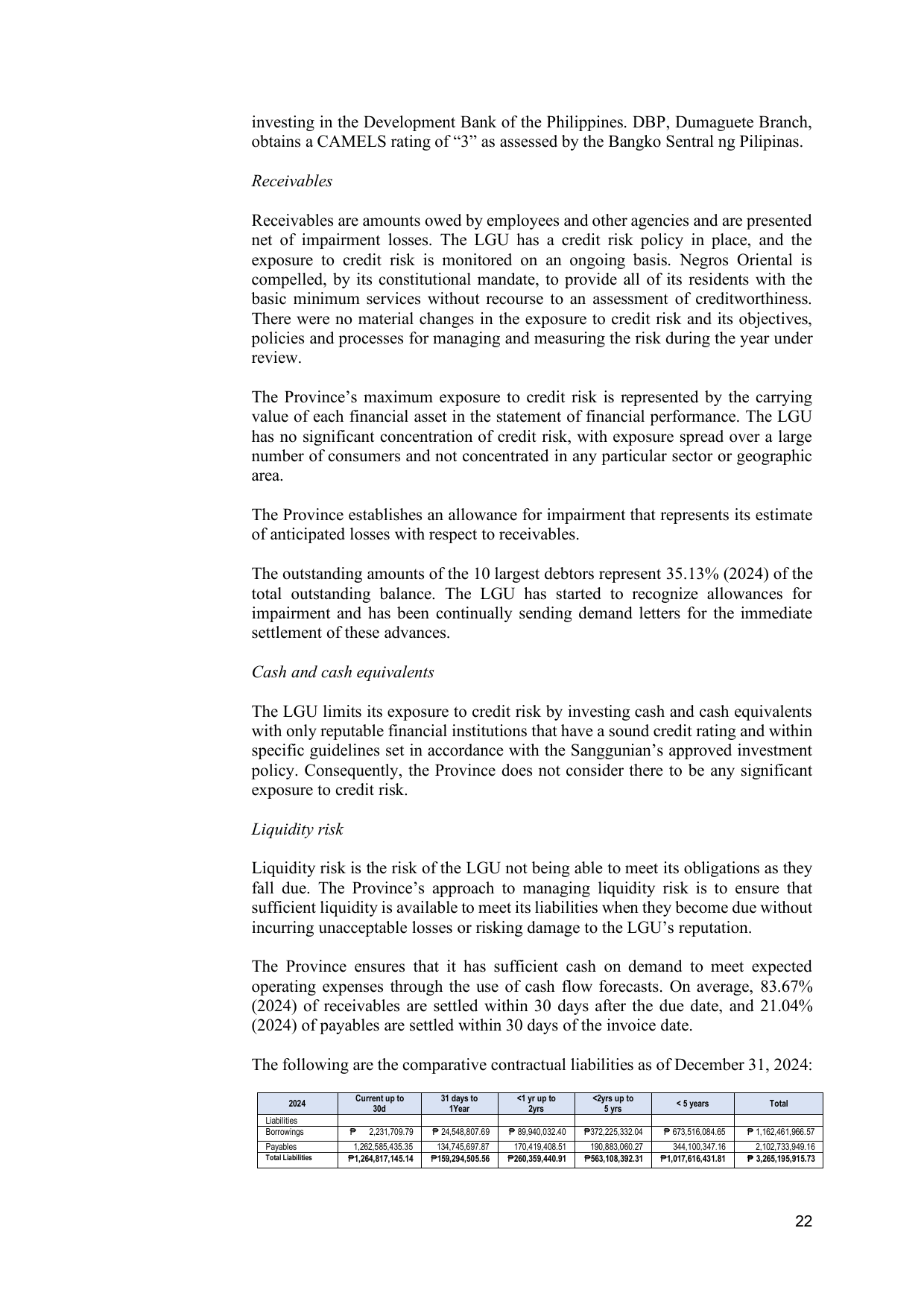
The following are the comparative contractual liabilities as of December 31, 2024:
                       Current up to        31 days to        <1 yr up to       <2yrs up to
          2024                                                                                      < 5 years            Total
                           30d                1Year              2yrs              5 yrs
  Liabilities
  Borrowings          ₱    2,231,709.79   ₱ 24,548,807.69   ₱ 89,940,032.40   ₱372,225,332.04   ₱ 673,516,084.65    ₱ 1,162,461,966.57
  Payables             1,262,585,435.35    134,745,697.87    170,419,408.51    190,883,060.27      344,100,347.16     2,102,733,949.16
  Total Liabilities   ₱1,264,817,145.14   ₱159,294,505.56   ₱260,359,440.91   ₱563,108,392.31   ₱1,017,616,431.81   ₱ 3,265,195,915.73


                                                                                                                                 22