9.3. Please be informed that only 6 out of 35 current recommendations have been fully
        implemented, while only 1 out of the 49 prior years’ recommendations has also been
        fully implemented satisfactorily by the relevant offices concerned.

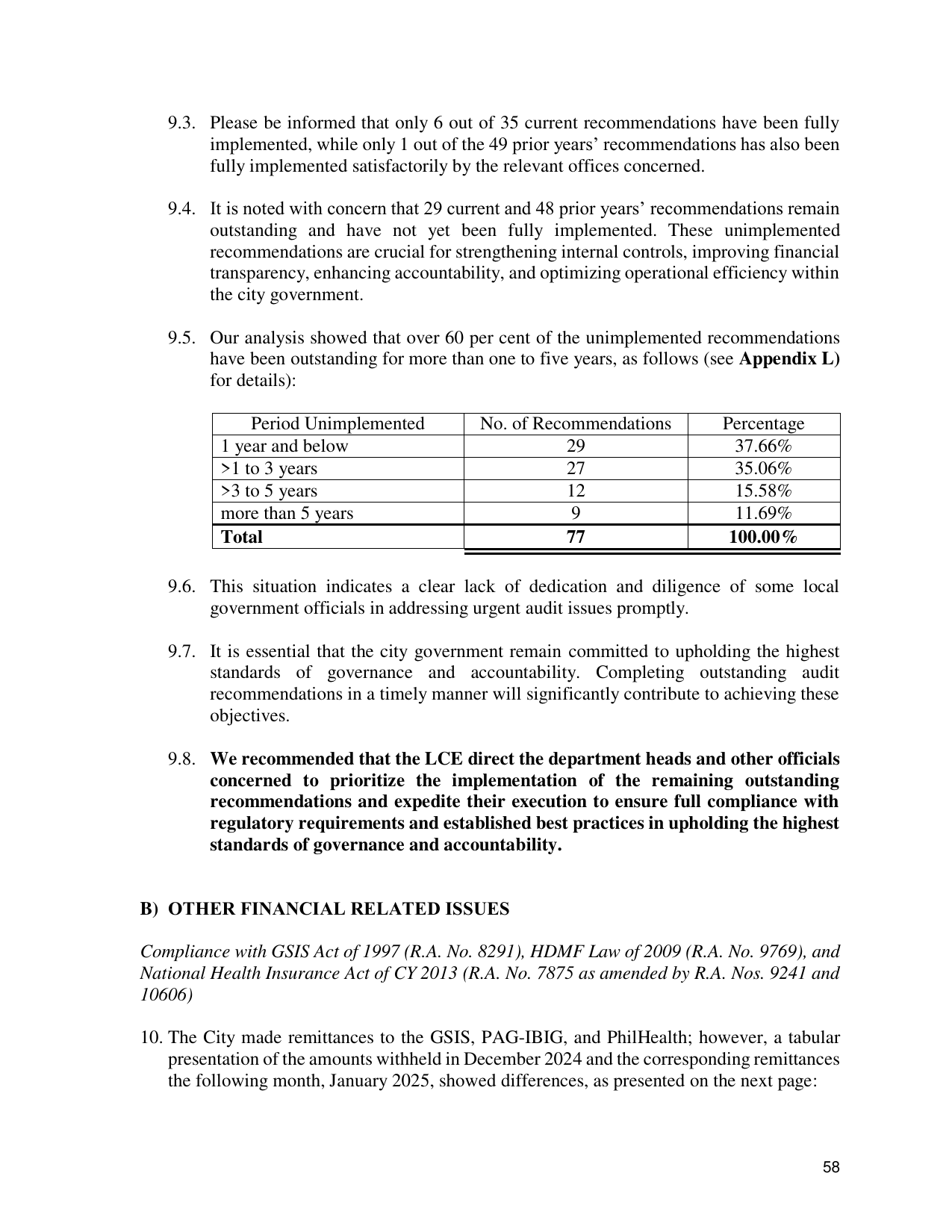
   9.4. It is noted with concern that 29 current and 48 prior years’ recommendations remain
        outstanding and have not yet been fully implemented. These unimplemented
        recommendations are crucial for strengthening internal controls, improving financial
        transparency, enhancing accountability, and optimizing operational efficiency within
        the city government.

   9.5. Our analysis showed that over 60 per cent of the unimplemented recommendations
        have been outstanding for more than one to five years, as follows (see Appendix L)
        for details):

              Period Unimplemented          No. of Recommendations          Percentage
          1 year and below                             29                     37.66%
          >1 to 3 years                                27                     35.06%
          >3 to 5 years                                12                     15.58%
          more than 5 years                             9                     11.69%
          Total                                        77                    100.00%

   9.6. This situation indicates a clear lack of dedication and diligence of some local
        government officials in addressing urgent audit issues promptly.

   9.7. It is essential that the city government remain committed to upholding the highest
        standards of governance and accountability. Completing outstanding audit
        recommendations in a timely manner will significantly contribute to achieving these
        objectives.

   9.8. We recommended that the LCE direct the department heads and other officials
        concerned to prioritize the implementation of the remaining outstanding
        recommendations and expedite their execution to ensure full compliance with
        regulatory requirements and established best practices in upholding the highest
        standards of governance and accountability.


B) OTHER FINANCIAL RELATED ISSUES

Compliance with GSIS Act of 1997 (R.A. No. 8291), HDMF Law of 2009 (R.A. No. 9769), and
National Health Insurance Act of CY 2013 (R.A. No. 7875 as amended by R.A. Nos. 9241 and
10606)

10. The City made remittances to the GSIS, PAG-IBIG, and PhilHealth; however, a tabular
    presentation of the amounts withheld in December 2024 and the corresponding remittances
    the following month, January 2025, showed differences, as presented on the next page:


                                                                                         58