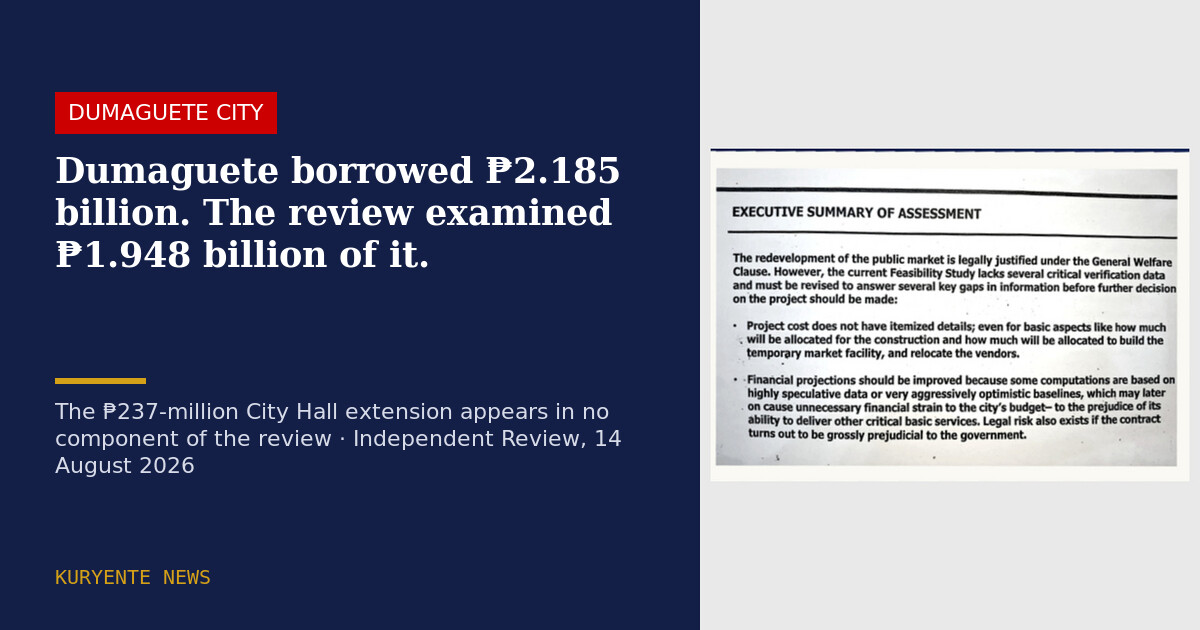
DUMAGUETE CITY — A city borrowing package of ₱2.185 billion has been examined by an independent review that looked at ₱1.948 billion of it. The remaining ₱237 million — a twin two-storey City Hall extension with parking area — appears in no component of the review record. No part of that record costed it, tested its assumptions, assessed its legal exposure, or modelled its effect on the city's debt service.
Within the ₱1.948-billion market component it did examine, the review found a feasibility study that cannot be acted on as written.
The legal component concluded the study "lacks several critical verification data and must be revised to answer several key gaps in information before further decision on the project should be made." The accounting component recommended the study "be revised to incorporate the foregoing refinements — given their materiality to the project's overall financial viability metrics — prior to final presentation to the Sangguniang Panlungsod."
Neither component states that the Sangguniang Panlungsod has enough information to vote.
The exposure that reaches signing officials personally
The legal component's central structural finding is not about the building. It is about who carries the liability.
Government financial institutions readily underwrite physical works because these constitute depreciable capital assets under IPSAS 17, and under DBM-DOF-DILG Joint Memorandum Circular No. 1, s. 2020, the city may lawfully use its 20% Local Development Fund to service loans for such eligible works.
Operational soft costs are treated differently. The review identifies the monthly rental of the temporary relocation site and the 24-month utility subsidies for relocated vendors as prohibited operational expenses under the same JMC No. 1, s. 2020, which cannot be amortized using the Local Development Fund.
Because the loan is a single ₱1.948-billion lump sum and 39 percent is paid via the LDF, the review concludes the city "is indirectly using restricted LDF funds to amortize prohibited soft costs." Under Section 342 of RA 7160, it finds, this "exposes signing officials to joint civil liability if COA issues a Notice of Disallowance."
Its recommendation is to consult the Commission on Audit regarding the loan structure. It also recommends obtaining official statements from Land Bank, DBP and other banks on whether they will approve a loan bundling both permanent physical assets and temporary operational subsidies into a single lot, and whether banks really do offer 4.5 percent fixed for an entire 15-year loan period — which the review notes is "not an ordinary practice based on other LGU loans."
One review, two components, opposite conclusions on 859 vendors
The review is one body working in components, and on the question most consequential to 859 vendor families its components do not agree.
The financial and accounting component — an Evaluation Report by Pinnacle Accounting & Consultancy Services Co. dated 3 August 2026, stamped received by the Sangguniang Panlungsod and prepared for the Office of the Sanggunian through Vice-Mayor Estanislao V. Alviola and Hon. Jose Victor V. Imbo, chairman of the Committee on Finance and Appropriation and Ways and Means, signed by Patrick P. Templado, Ramil D. Repe and Frederick C. Roda, all CPAs — describes the relocation package as settled and commends it.
It states that the developer shall provide and construct a three-hectare temporary market facility at no cost to vendors, that vendors occupying the temporary facility will not be charged stall rentals for the entire duration of the construction period, that all affected vendors are assured priority reinstatement, and that rates will not be subjected to abrupt or steep increases after the grace period. Under its summary of recommendations for socio-economic analysis, it enters: "No corrective action required."
The legal and policy component — an Independent Review by Atty. Golda S. Benjamin, who headed the review, dated 14 August 2026 — examines the same feasibility study and finds critical logistical data entirely missing. Her assessment records the contractor's obligation as one to "locate and lease" a three-hectare staging area, and lists what the study does not answer: where exactly the site is; who owns it; the projected rental; whether the city, if it owns the property, holds it free from any issue that would delay the project; the current zoning classification; by how much the contractor will subsidize utility payments; whether relocation will happen all at once; who bears the extended rental cost if construction goes beyond two years; and whether stallholders will start paying rent after two years while still in the temporary facility.
Elsewhere she asks whether a three-hectare lot within a five-kilometre radius still exists for the site at all, and whether the relocation area is residential, has a waste management system, or will cause severe local odour and traffic.
One component describes an arrangement in place. The other finds an unlocated site with no lease, no zoning clearance and no named cost-bearer. Both were produced under the same review mandate. Both are in the Sanggunian's file.
Three construction periods in one record
The study's stated duration is 24 months.
The accounting component's disbursement table spreads construction-in-progress across three years — ₱779,200,000 in 2027, ₱584,400,000 in 2028 and ₱584,400,000 in 2029 — and its Section 2.12 identifies 2027 to 2029 as the "pre-revenue period" when rental collections would not yet be available. The same document describes the rent-free window in one passage as covering "the entire duration of the construction period" and in another as a "one-year grace period."
Benjamin's unanswered question — who bears the cost if construction goes beyond two years — is not hypothetical. The review's own cash-flow schedule already runs to three.
What the numbers show
The cost is not itemized. The review's executive summary states the project cost "does not have itemized details; even for basic aspects like how much will be allocated for the construction and how much will be allocated to build the temporary market facility, and relocate the vendors." Its financing section repeats the flag.
₱1.948 billion buys 91 additional stalls. Existing stalls number 859; the proposed structure has 950 — a net addition of 91, or 10.6 percent. The review asks directly whether that net addition "justifies a ₱1.948 Billion investment in a city dealing with extensive informal street vending."
₱2.670 billion total repayment on a ₱1.948-billion principal at 4.5 percent fixed over 15 years. The review flags that the study contains no computations for when the loan will have to be repriced due to changing interest rates, and that "the total payment could be significantly higher."
₱87.66 million in interest falls due in each of the first two years against ₱0.00 in market revenue. Year 1 (2027) is funded ₱41.56 million from the 20% LDF and ₱46.09 million from the General Fund; Year 2 (2028), ₱46.13 million LDF and ₱41.52 million General Fund.
From Year 3 the burden roughly triples:
| Phase | Total bank payment due | LDF | Speculative market revenue | General Fund |
|---|---|---|---|---|
| Year 3 | ₱237.5 M | ₱83.1 M | ₱80.6 M | ₱73.8 M |
| Year 4 | ₱231.5 M | ₱81.0 M | ₱80.6 M | ₱69.8 M |
| Year 5 | ₱225.5 M | ₱78.9 M | ₱80.6 M | ₱65.9 M |
| Year 6 | ₱219.7 M | ₱76.8 M | ₱81.9 M | ₱60.9 M |
| Year 7 | ₱213.8 M | ₱74.8 M | ₱83.3 M | ₱55.6 M |
The review labels the market revenue column "speculative" in its own table.
The development fund it draws on is ₱161.60 million. The review's breakdown of current allocations, based on 2022–2025 Annual Investment Program baseline averages:
| Sector / programme line | Annual allocation | Share of LDF |
|---|---|---|
| Local roads, drainage & public infrastructure | ₱34.60 M | 21.4% |
| Banica River flood control & drainage works | ₱29.00 M | 17.9% |
| Health, nutrition & sanitation programs | ₱24.00 M | 14.9% |
| Aid to component barangays | ₱22.00 M | 13.6% |
| Indigent families & crisis assistance | ₱16.00 M | 9.9% |
| Education, sports & youth development | ₱14.00 M | 8.7% |
| Environment, solid waste & climate resilience | ₱12.00 M | 7.4% |
| Agriculture, livelihood & enterprise support | ₱10.00 M | 6.2% |
| Total 20% Local Development Fund | ₱161.60 M | 100% |
The review's question beneath that table: "Which items will most likely suffer a funding cut to pay for this loan? What is the historical utilisation rate of the LDF? Does it show flexibility to accommodate the portion to be allocated to debt payment?"
The market has never earned what the model requires. The review sets the required annual revenue at ₱80 million and above against historical peak gross revenue of roughly ₱30 million to ₱35 million, and a historical net position of deficit. Citing City Accountant and COA reports, it finds the existing market "has operated at a chronic operating deficit for 7 of the last 8 years," requiring annual General Fund subsidies ranging from ₱11.7 million to ₱16.2 million just to survive. It calls the study's assumption "problematic": that "a brand-new building will instantly reverse decades of deficits and more than double historical peak revenues."
₱909,244,231.54 in unrecognized tax. The accounting component found the study's characterization of market income as "socially oriented" and therefore non-taxable no longer holds under Revenue Memorandum Circular No. 89-2024, issued 13 August 2024, which subjects LGU proprietary income — including public market operations — to 12 percent VAT, Percentage Tax, Documentary Stamp Tax, and withholding and income taxes. The component states this omission "currently overstates the study's projected net surplus and payback metrics by an estimated ₱909.2 million through Year 2055."
The payback figure was not recomputed after that finding. The accounting component reports a simple cash payback period of 26 years and 3 months against a 30-year project horizon, describes it as "considerably extended" relative to typical LGU economic enterprise benchmarks, and warns that a payback beyond 26 years implies the LGU "will be carrying debt service obligations funded substantially from general government resources for the greater part of two decades — a commitment that reduces fiscal flexibility for other priority programs and capital projects during that window." It nonetheless affirms the project financially viable on that figure, without restating it to absorb the ₱909.2-million liability it had identified as materially overstating the same metric.
₱78.9 million in interest turns on drawdown timing. The loan is modelled as released in full at Year 1 while construction is disbursed over three years. Had drawdowns been phased to match, interest at the same 4.5 percent would have been approximately ₱184.1 million over the construction period, against approximately ₱263.0 million under full upfront release. The component presents the variance for information and recommends the LGU confirm with the lending institution whether the drawdown terms were lender-mandated or LGU-elected, and identify any placement income earned on undisbursed proceeds.
Procurement steps the review says are missing
Design and Build is a legally recognized modality under Section 14.1 of the RA 12009 IRR. The review's question is whether the city has completed the site-readiness and cost-verification steps the law requires before bidding.
No source for the cost rate. The ₱1.948-billion figure is derived by applying a ₱42,000–₱45,000 per square metre rate to 35,800 sqm of gross floor area. The review states the feasibility study "cites no regional DPWH guideline, historical bid record, or cost index to support that rate," and recommends an independent quantity-surveyor market-scoping audit under Section 10.4.1 to "remove any perception of an inflated Approved Budget for the Contract."
No geotechnical work before bid advertisement. The review calls for independent multi-point core tests commissioned prior to bidding, warning that deferring them to the contractor "invites post-award Variation Orders up to the 10% statutory limit — ₱194.8 Million" under Section 71.2 of the RA 12009 IRR. It notes sandy coastal soil conditions as a specific exposure a contractor could exploit.
No verified site availability. Sections 12.5 and 8.1.1 require verified site availability and permits to enter before award. The review states no award should proceed without them.
The review cites four COA precedents. In Dumanjug, Cebu, COA flagged the municipality for rounding off its public market contract cost to ₱300 million from an ABC of ₱299.4 million; the stated lesson is that proceeding with large capital projects without detailed, itemized cost-index verifications invites immediate audit suspensions. In Minglanilla, Cebu, COA flagged critical delays on a ₱399-million government complex where the contractor was granted time extensions due to uncompleted site relocation works; the lesson drawn is that bundling relocation milestones inside a Design and Build contract without ex-ante site readiness results in project stalls and zero penalty recovery. In the City of Manila, COA urged the city to seek legal action against private developers of six city-owned public markets who defaulted on revenue shares totalling ₱22.41 million. At the Cebu City Carbon Market, COA flagged a multi-billion redevelopment for failing to collect ₱150 million in guaranteed payments due to a lack of pre-approved regulatory structures; the lesson is never to proceed with massive vendor displacement without a finalized and approved Local Revenue Code.
Assumptions the review found over-optimistic
11 percent compounding NTA growth. The review calls this "out of the usual practice for conservative government borrowing" and sets it against Dumaguete's actual record: ₱860.5 million in 2022, a 38.0 percent one-time Mandanas spike; ₱736.3 million in 2023, a 14.4 percent severe contraction; ₱782.5 million in 2024, a 6.2 percent recovery. It identifies the structural flaw as compounding maximum historical growth rates across 15-plus straight years without budgeting for economic downturns, when NTA is tied to national tax collections from three years prior. The accounting component independently flags the CY2022 and CY2023 growth rates as diverging notably from trend, recommending they be reviewed as outliers and the computation basis expanded to ten years.
10 percent compounding local revenue growth. Actual figures cited: ₱385.2 million in 2021, up 2.1 percent; ₱430.5 million in 2022, up 11.7 percent on reopening; ₱465.8 million in 2023, up 8.2 percent. The review notes residents are already raising concerns the loan may lead to aggressive increases in local taxes and fees.
₱1,000 per square metre for premium commercial space. The review calls this "highly speculative," rivalling private mall rates with no independent appraisal proving commercial brands will pay it. It also flags an internal contradiction: the study states no supermarket is proposed yet designs nine anchor stores, and recommends an ordinance barring corporate chains from those spaces so they cannot undercut local micro-vendors.
₱15 per hour parking. Fair in theory, the review finds, but carrying high enforcement risk — strict fees may drive consumers to private supermarkets with free parking, leaving revenue unmet. It asks whether the projected number of slots is compliant with the Building Code.
"Solar arbitrage." The review calls the assumption problematic: that the city will charge vendors full NORECO grid electricity rates for power generated freely by the city's own solar panels.
12 hours of daily solar generation. The accounting component finds this figure "appears to be based on the approximate length of daylight in the Philippines rather than on the actual productive output period of a photovoltaic system," and notes reductions from monsoon season and degradation during overcast, rainy or typhoon conditions were not modelled.
1,300 kW power demand. The component finds this requires stronger empirical support and lists four factors not yet incorporated: solar panel degradation, peak load requirements, minimum expected output on rainy or overcast days, and whether exported power would sufficiently offset power imported from NORECO II. It notes stalls trade only in daytime while nighttime demand continues for perimeter lighting, CCTV and cold storage, and that under net metering the export rate is typically lower than the import rate.
7 percent compounding fee escalation from Year 6 (2031). The review finds this "nearly double rental overheads for all 859 stallholders by Year 15," and recommends it be codified as a step-by-step rent schedule in a Market Ordinance subject to public hearings — "not locked in as a non-negotiable bank covenant."
₱400 flat-rate water fee. The legal component calls it inequitable, penalizing dry-goods vendors who use virtually zero water compared to the fish and meat sections. The accounting component finds it fails to capture variation across business profiles and may reduce conservation incentive, recommending five years of billing records be obtained from Metro Dumaguete Water and analysed by stall category.
Personnel services. Actual costs ran between ₱12 million and ₱17 million from 2018 to 2025; the 2026 projection is ₱23 million. The accounting component asks for the basis of the increase, including positions, salary grades and benefits.
The review also sets out what the cost will mean for the public: vendors on thin margins passing the 7 percent annual rent hikes and ₱400 water fees down to consumers, raising the price of fish, meat and vegetables — "essentially taxing citizens indirectly to pay for the building" — alongside ₱15-per-hour parking in a public facility.
Methodological gaps
The research instrument was never presented. The accounting component states that "the research instrument used to establish the basis for certain revenue assumptions was not presented in the study," and lists the assumptions needing quantified support: occupancy of the additional 91 stalls at Year 2; receptiveness to the 7 percent escalation applied to all fees; occupancy of the anchor stores; utilization of the parking spaces; events per week at the function hall and multipurpose rooms; auditorium rate competitiveness against hotels and event venues; and comfort room capacity.
The same component nonetheless enters "No corrective action required" for market and demand analysis, stating the study's demand assumptions are well-supported by established patronage, sustained foot traffic and current occupancy levels.
Other gaps recorded across the review: no itemized Bill of Quantities separating capital expenditure from operating expenditure; no independent geotechnical soil boring logs before bid advertisement; no relocation masterplan with mapped plot, notarized lease and zoning clearance; no traffic and transit study for the transition period; no technical sub-metering at the temporary facility; no draft revised Market Code — the current structure dates to 1988, at roughly ₱4.25 per day on some stalls, unadjusted for nearly four decades; no organizational chart for the electrical engineer, parking fee collector, multimedia technician and meter reader the new facilities require; depreciation applied as a single 30-year life across all assets, when office equipment and furniture run 5 to 10 years and machinery 10 years, with no replacement provisions; borrowing cost capitalization not ceasing at practical completion as PPSAS 5 requires; and General Fund projections omitting the operating subsidy needed during the 2027–2029 pre-revenue period, with no record of consultation with health, education, tourism or other City offices on the impact of the increased subsidy allocation.
Four policy mandates put to the Council
The legal component sets out four measures for the Sangguniang Panlungsod. It calls for a cost-disaggregation ordinance directing formal disaggregation of the Program of Work, stating this "protects signing officials from Joint Liability and COA disallowances." It calls for a sinking fund ordinance — the review's heading reads "LEE Sinking Fund" — to legally ring-fence market revenues. It calls for a pre-operations reserve, pre-funded by surpluses from other high-performing local economic enterprises, to cover the ₱87.66-million annual interest "without starving regular local services." And it calls for a pre-award veto resolution requiring the winning contractor's final Detailed Engineering Design to be presented to and approved by the Council before the Notice to Proceed is issued, flagging that "the Council can no longer question the design of the contractor once the loan is approved."
The legal component states that each of its six verification benchmarks — the Bill of Quantities, geotechnical logs, relocation masterplan, traffic and transit study, technical sub-metering and draft revised Market Codes — "protects signing officials, public funds, and the project's credibility," and that all should appear in the feasibility study before final loan authorization.
The ₱237 million no component examined
The accounting component's mandate was expressly limited. It states that "the focus of the accounting team is on the feasibility study's financial assumptions and viability" — not procurement compliance, site readiness, Local Development Fund eligibility, or exposure under RA 7160 and RA 12009. Those questions fell to the legal component. Its conclusion that the project "remains a financially viable and strategically sound investment" is conditioned on revisions it says must be made before final presentation to the Sanggunian.
Neither component examined the City Hall extension.
That matters to the findings both components did make. The debt-service compliance the review cites — a BLGF certification under Section 324(b) of the Local Government Code — is described in relation to the market borrowing. The soft-cost and Local Development Fund analysis turns on the loan being a single lump sum of ₱1.948 billion. The accounting component's recommendation to secure BLGF Net Debt Service Ceiling and Borrowing Capacity certification was framed against the same component. The Council has not been shown what the ₱2.185-billion package does to any of those findings.
Documents obtained separately by this newsroom, which formed no part of the review record, indicate the financing is not structured as the single facility the study models. Land Bank of the Philippines Board Resolution No. 26-243, approved 22 April 2026 under Credit Facilities Proposal No. RL2/2026/255726/CFP dated 5 March 2026, covers a ₱974-million Term Loan 1, described as 50 percent of the construction cost of the new four-storey public market, and a ₱237-million Term Loan 2 for the City Hall extension with parking.
That is precisely the question the review's legal component told the city to put to its lenders in writing — whether any government financial institution will underwrite the structure the feasibility study assumes, and whether 4.5 percent fixed for 15 years is available at all.