beginning of the year, the Treasurer shall furnish the Chief Accountant of
         a duly certified list showing the name of taxpayers and the amount due
         and collectible for the year. Based on the list, the Chief Accountant shall
         draw a Journal Entry Voucher (JEV) to record the debit to Real Property
         Tax Receivable/Special Education Tax Receivable and crediting to
         Deferred Real Property Tax Income/Deferred Special Education Tax
         Income.” (Emphasis ours)

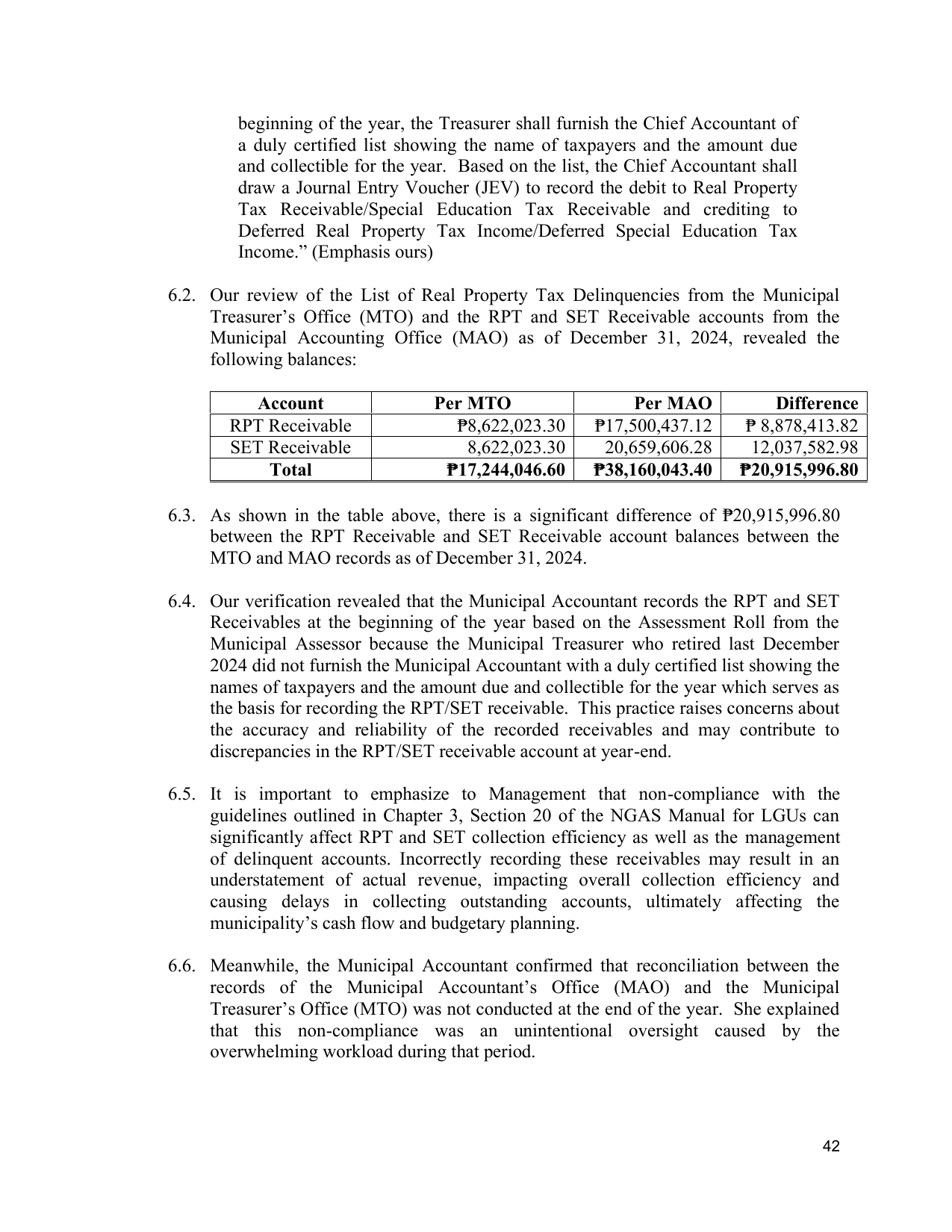
6.2. Our review of the List of Real Property Tax Delinquencies from the Municipal
     Treasurer’s Office (MTO) and the RPT and SET Receivable accounts from the
     Municipal Accounting Office (MAO) as of December 31, 2024, revealed the
     following balances:

          Account                  Per MTO                   Per MAO             Difference
        RPT Receivable               ₱8,622,023.30      ₱17,500,437.12       ₱ 8,878,413.82
        SET Receivable                 8,622,023.30      20,659,606.28        12,037,582.98
            Total                   ₱17,244,046.60      ₱38,160,043.40      ₱20,915,996.80

6.3. As shown in the table above, there is a significant difference of ₱20,915,996.80
     between the RPT Receivable and SET Receivable account balances between the
     MTO and MAO records as of December 31, 2024.

6.4. Our verification revealed that the Municipal Accountant records the RPT and SET
     Receivables at the beginning of the year based on the Assessment Roll from the
     Municipal Assessor because the Municipal Treasurer who retired last December
     2024 did not furnish the Municipal Accountant with a duly certified list showing the
     names of taxpayers and the amount due and collectible for the year which serves as
     the basis for recording the RPT/SET receivable. This practice raises concerns about
     the accuracy and reliability of the recorded receivables and may contribute to
     discrepancies in the RPT/SET receivable account at year-end.

6.5. It is important to emphasize to Management that non-compliance with the
     guidelines outlined in Chapter 3, Section 20 of the NGAS Manual for LGUs can
     significantly affect RPT and SET collection efficiency as well as the management
     of delinquent accounts. Incorrectly recording these receivables may result in an
     understatement of actual revenue, impacting overall collection efficiency and
     causing delays in collecting outstanding accounts, ultimately affecting the
     municipality’s cash flow and budgetary planning.

6.6. Meanwhile, the Municipal Accountant confirmed that reconciliation between the
     records of the Municipal Accountant’s Office (MAO) and the Municipal
     Treasurer’s Office (MTO) was not conducted at the end of the year. She explained
     that this non-compliance was an unintentional oversight caused by the
     overwhelming workload during that period.


                                                                                       42