Amortization (56 Equal
                                  Date of         Start of
Description     Loan Balance                                        Quarterly Amortization)
                                  Maturity      Amortization
                                                                    Current     Non-Current
Government
              ₱66,075,250.97 10/19/2038          01/20/2025      ₱4,719,660.78 ₱61,355,590.19
Center
Plaza
                5,999,729.91 10/19/2038          01/20/2025         428,552.14       5,571,177.77
Development
Construction
of Jetty Port  20,324,536.60 10/19/2038          01/20/2025       1,451,752.61      18,872,783.99
and Terminal
Construction
and
                2,999,617.02 10/19/2038          01/20/2025         214,258.36       2,785,358.66
Renovation
of Cottages
Acquisition
of Lot for
                  570,180.00 10/19/2039          01/02/2026                0.00        570,180.00
Jetty Ports
and Road
Prior Year’s
                    3,795.67 unknown              unknown                  0.00           3,795.67
Account
TOTAL         ₱95,973,110.17                                     ₱6,814,223.89 ₱89,158,886.28

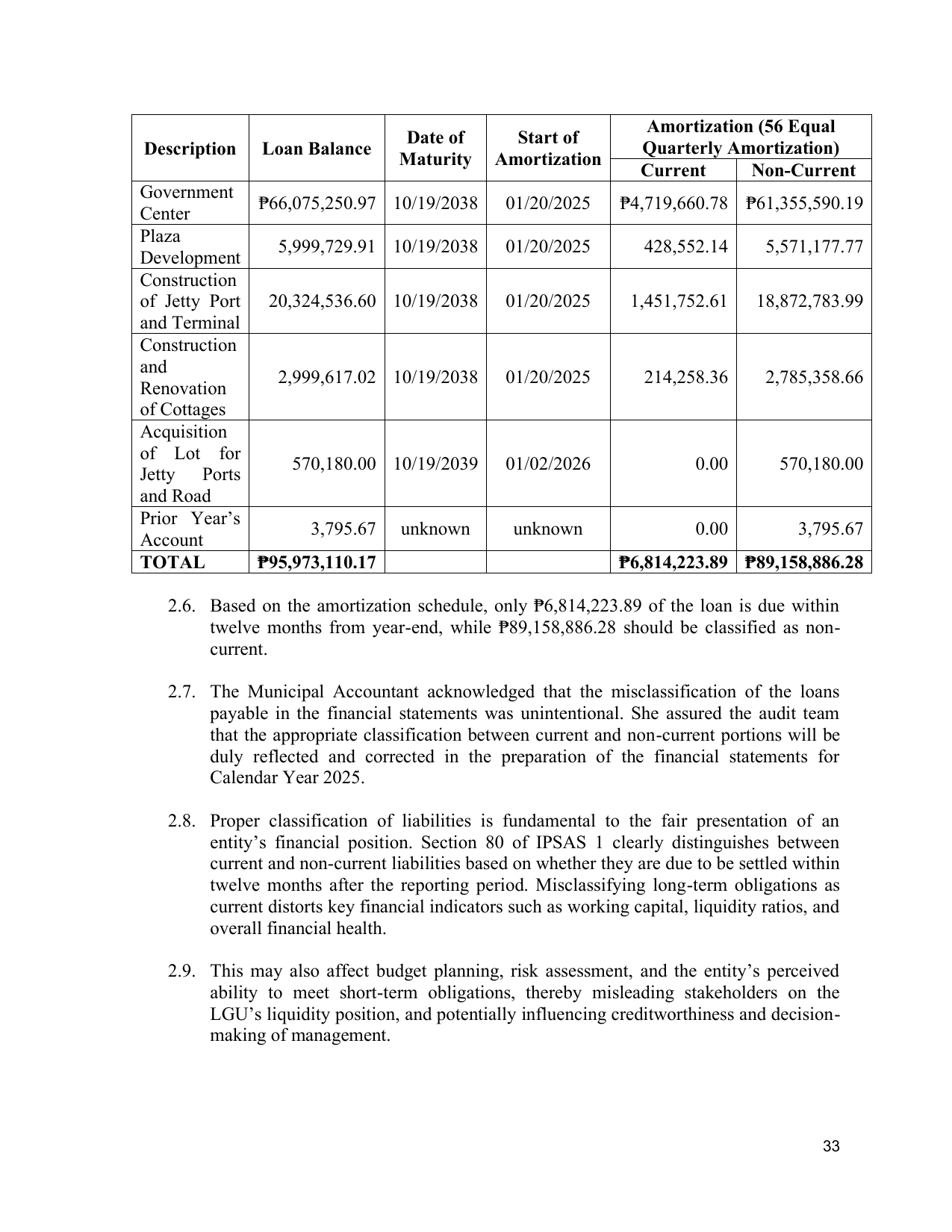
   2.6. Based on the amortization schedule, only ₱6,814,223.89 of the loan is due within
        twelve months from year-end, while ₱89,158,886.28 should be classified as non-
        current.

   2.7. The Municipal Accountant acknowledged that the misclassification of the loans
        payable in the financial statements was unintentional. She assured the audit team
        that the appropriate classification between current and non-current portions will be
        duly reflected and corrected in the preparation of the financial statements for
        Calendar Year 2025.

   2.8. Proper classification of liabilities is fundamental to the fair presentation of an
        entity’s financial position. Section 80 of IPSAS 1 clearly distinguishes between
        current and non-current liabilities based on whether they are due to be settled within
        twelve months after the reporting period. Misclassifying long-term obligations as
        current distorts key financial indicators such as working capital, liquidity ratios, and
        overall financial health.

   2.9. This may also affect budget planning, risk assessment, and the entity’s perceived
        ability to meet short-term obligations, thereby misleading stakeholders on the
        LGU’s liquidity position, and potentially influencing creditworthiness and decision-
        making of management.


                                                                                             33