EXECUTIVE SUMMARY

Introduction

The Municipality of Mabinay was created by virtue of Republic Act No. 2496, under the
sponsorship of then-Congressman Lorenzo G. Teves on June 21, 1956. It is located in the
central part of Negros Island with a total land area of 319.44 square kilometers, composed of
32 barangays. Being an interior town, Mabinay is about 87 kilometers northwest of the
Provincial Capitol, located in Dumaguete City. Based on the CY 2020 census, its population
was reported at 82,953. It is presently classified as a first-class municipality.

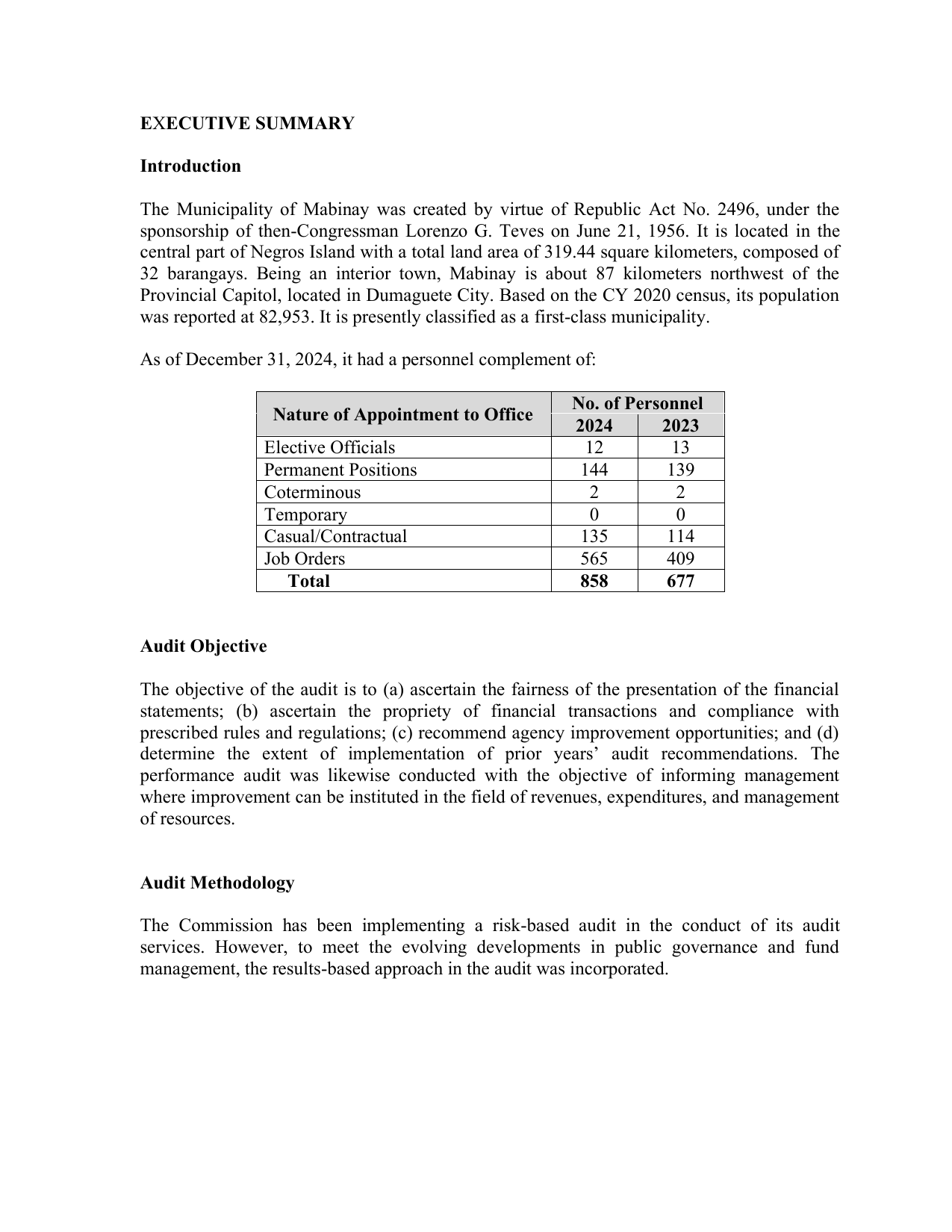
As of December 31, 2024, it had a personnel complement of:

                                                           No. of Personnel
                  Nature of Appointment to Office
                                                           2024       2023
                 Elective Officials                          12         13
                 Permanent Positions                        144        139
                 Coterminous                                  2         2
                 Temporary                                    0         0
                 Casual/Contractual                         135        114
                 Job Orders                                 565        409
                    Total                                   858        677


Audit Objective

The objective of the audit is to (a) ascertain the fairness of the presentation of the financial
statements; (b) ascertain the propriety of financial transactions and compliance with
prescribed rules and regulations; (c) recommend agency improvement opportunities; and (d)
determine the extent of implementation of prior years’ audit recommendations. The
performance audit was likewise conducted with the objective of informing management
where improvement can be instituted in the field of revenues, expenditures, and management
of resources.


Audit Methodology

The Commission has been implementing a risk-based audit in the conduct of its audit
services. However, to meet the evolving developments in public governance and fund
management, the results-based approach in the audit was incorporated.