EXECUTIVE SUMMARY

Introduction

The Municipality of Bacong, Negros Oriental was officially recorded and published in the
Spanish Journal of 1801 as El Barangay de Bacong Pueblo de Dumaguete. It is a fourth-
class Municipality located on the southeastern coast of Negros Oriental and the first town
located eight kilometers south of Dumaguete City. It has a total land area of 4,126.67
hectares, consisting of 22 barangays.

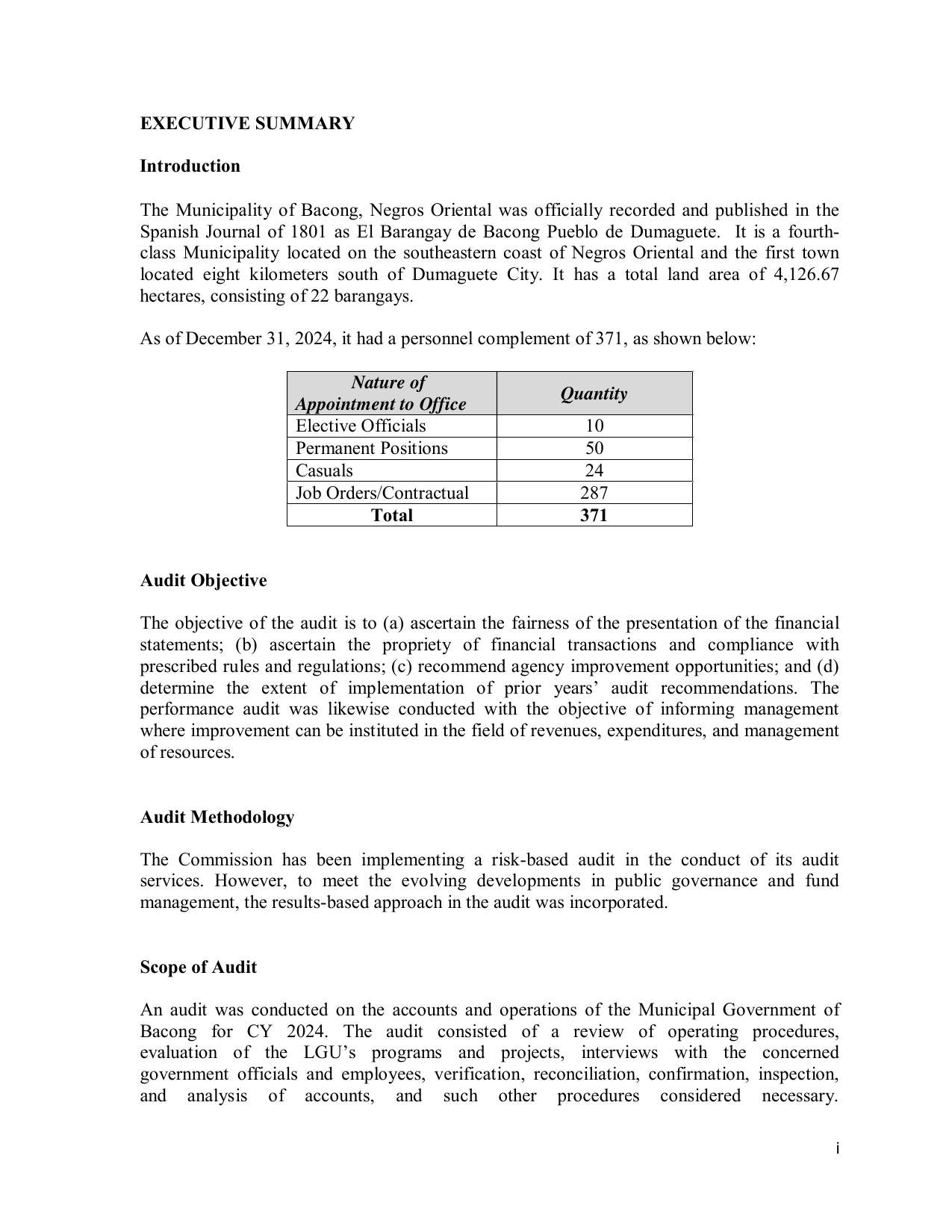
As of December 31, 2024, it had a personnel complement of 371, as shown below:

                            Nature of
                                                         Quantity
                     Appointment to Office
                     Elective Officials                      10
                     Permanent Positions                     50
                     Casuals                                 24
                     Job Orders/Contractual                 287
                               Total                        371


Audit Objective

The objective of the audit is to (a) ascertain the fairness of the presentation of the financial
statements; (b) ascertain the propriety of financial transactions and compliance with
prescribed rules and regulations; (c) recommend agency improvement opportunities; and (d)
determine the extent of implementation of prior years’ audit recommendations. The
performance audit was likewise conducted with the objective of informing management
where improvement can be instituted in the field of revenues, expenditures, and management
of resources.


Audit Methodology

The Commission has been implementing a risk-based audit in the conduct of its audit
services. However, to meet the evolving developments in public governance and fund
management, the results-based approach in the audit was incorporated.


Scope of Audit

An audit was conducted on the accounts and operations of the Municipal Government of
Bacong for CY 2024. The audit consisted of a review of operating procedures,
evaluation of the LGU’s programs and projects, interviews with the concerned
government officials and employees, verification, reconciliation, confirmation, inspection,
and analysis of accounts, and such other procedures considered necessary.

                                                                                               i