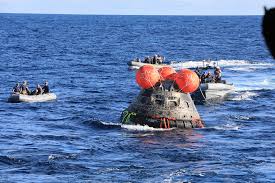
NASA's Artemis II astronauts returned safely to Earth Friday evening, completing a historic 10-day mission that marked humanity's first crewed voyage around the Moon in more than half a century. The successful splashdown in the Pacific Ocean represents a major milestone for space exploration and NASA's ambitious lunar program.
The Orion spacecraft, nicknamed "Integrity," touched down in the Pacific Ocean approximately 40 to 50 miles off the coast of San Diego at 8:07 p.m. ET on Friday. Mission Control described the landing as "a perfect bullseye splashdown," with commander Reid Wiseman confirming that all four crew members were in good condition following their return.
The mission lasted exactly 9 days, 1 hour, 32 minutes and 15 seconds, covering a total distance of 694,481 miles. NASA's flight dynamics team recorded the precise splashdown time at 8:07 p.m. and 27 seconds ET, marking the end of a journey that took the crew farther from Earth than any humans have traveled before.
Four-Person International Crew Makes Space History
The Artemis II crew consisted of three NASA astronauts and one Canadian Space Agency representative. Commander Reid Wiseman led the mission alongside pilot Victor Glover and mission specialist Christina Koch, all from NASA. Canadian Space Agency astronaut Jeremy Hansen completed the four-person team.
During their historic journey, the crew became the first humans to travel toward the Moon in more than 50 years. The mission established a new record for the farthest distance humans have ever traveled from Earth, surpassing previous achievements in space exploration.
According to pilot Victor Glover, one of the mission's most memorable moments occurred when the crew witnessed the sun disappear behind the Moon in a solar eclipse. Glover described the phenomenon as "one of the greatest gifts of that part of the mission."
Critical Reentry Phase Overcomes Technical Challenges
The splashdown marked the successful completion of what NASA officials had identified as the highest-risk phase of the entire mission. The Orion capsule's reentry carried unusual concern due to known issues with the spacecraft's thermal protection system.
Orion's heat shield, the critical component that protects astronauts from extreme temperatures during atmospheric reentry, had documented design flaws. To address these concerns, NASA implemented a modified reentry path for the capsule, with Orion descending faster and at a steeper angle to minimize exposure time to the highest temperatures.
As the spacecraft descended through approximately 400,000 feet of altitude, it entered a planned six-minute communications blackout beginning at 7:53 p.m. ET. During this phase, plasma formed around the capsule during peak heating, with the crew experiencing forces up to 3.9 times Earth's gravity.
The capsule successfully endured temperatures approaching 3,000 degrees Fahrenheit during the reentry process. After emerging from the communications blackout, Orion executed its planned landing sequence flawlessly.
Precision Landing Sequence Executed Successfully
Following the communications blackout, Orion jettisoned its forward bay cover and deployed drogue parachutes at approximately 22,000 feet altitude. The spacecraft then unfurled three main parachutes near 6,000 feet to slow the capsule sufficiently for its Pacific Ocean landing.
The parachute system performed as designed, carrying the capsule down to a safe water landing in the designated recovery zone. NASA's recovery teams were positioned and ready to retrieve the crew immediately following splashdown.
Two recovery personnel dove into the ocean immediately after splashdown to photograph the heat shield, aiming to gather critical data about its performance during the flight. This information will directly inform NASA's planning for Artemis III, the agency's planned crewed lunar landing mission.
Post-Mission Recovery and Medical Evaluations
Teams from NASA and the U.S. military conducted the crew extraction from the Orion capsule following established protocols. The astronauts were transported via helicopter to the USS John P. Murtha, where they underwent comprehensive post-mission medical evaluations.
Following their medical assessments aboard the naval vessel, the crew returned to shore and boarded an aircraft bound for NASA's Johnson Space Center in Houston. The medical evaluations are standard procedure following extended space missions to ensure crew health and gather data for future missions.
NASA Administrator Jared Isaacman expressed his amazement at the successful splashdown, noting that cheers erupted at Johnson Space Center when post-reentry communications were confirmed clear. The successful completion removes a major hurdle for NASA's continued lunar exploration program.
Historic Lunar Flyby Marks Return to Moon Vicinity
The Artemis II mission accomplished a historic lunar flyby, representing humanity's return to the vicinity of the Moon for the first time in more than five decades. The last crewed mission to the Moon occurred during the Apollo program era in the 1970s.
The successful completion of Artemis II validates critical systems and procedures that will support future lunar missions. The mission tested life support systems, navigation capabilities, and spacecraft performance during extended deep space operations.
Data collected during the mission will inform the design and planning of Artemis III, which aims to land astronauts on the lunar surface. The heat shield performance data being gathered from the splashdown will be particularly crucial for ensuring crew safety during future missions.
Implications for Future Space Exploration
The successful Artemis II mission represents a significant step forward in NASA's broader goals for space exploration. The mission validated key technologies and procedures that will support not only lunar landing missions but potentially future missions to Mars and other destinations.
The international collaboration demonstrated through the inclusion of Canadian Space Agency astronaut Jeremy Hansen highlights the global nature of modern space exploration efforts. This cooperation model is expected to continue in future Artemis program missions.
With Artemis II now complete, NASA can proceed with confidence toward Artemis III planning. The agency aims to return humans to the lunar surface for the first time since the Apollo program, building on the technical achievements and operational experience gained during this historic mission around the Moon.
Photo credit: NASA