Depreciation on assets is charged on a straight-line basis over the useful life of the
   asset.

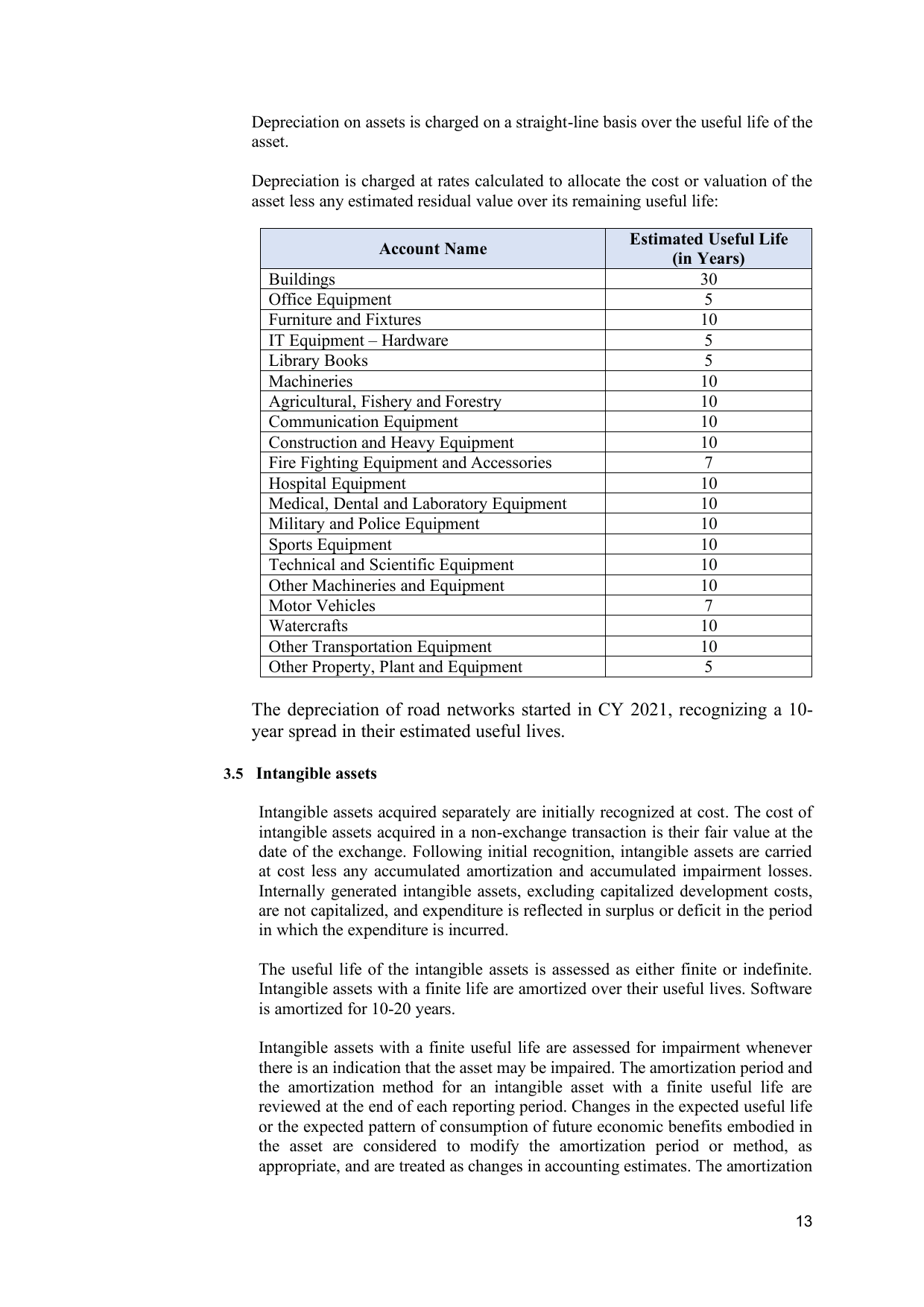
   Depreciation is charged at rates calculated to allocate the cost or valuation of the
   asset less any estimated residual value over its remaining useful life:

                                                            Estimated Useful Life
                        Account Name
                                                                 (in Years)
      Buildings                                                      30
      Office Equipment                                                5
      Furniture and Fixtures                                         10
      IT Equipment – Hardware                                         5
      Library Books                                                   5
      Machineries                                                    10
      Agricultural, Fishery and Forestry                             10
      Communication Equipment                                        10
      Construction and Heavy Equipment                               10
      Fire Fighting Equipment and Accessories                         7
      Hospital Equipment                                             10
      Medical, Dental and Laboratory Equipment                       10
      Military and Police Equipment                                  10
      Sports Equipment                                               10
      Technical and Scientific Equipment                             10
      Other Machineries and Equipment                                10
      Motor Vehicles                                                  7
      Watercrafts                                                    10
      Other Transportation Equipment                                 10
      Other Property, Plant and Equipment                             5

   The depreciation of road networks started in CY 2021, recognizing a 10-
   year spread in their estimated useful lives.

3.5 Intangible assets

    Intangible assets acquired separately are initially recognized at cost. The cost of
    intangible assets acquired in a non-exchange transaction is their fair value at the
    date of the exchange. Following initial recognition, intangible assets are carried
    at cost less any accumulated amortization and accumulated impairment losses.
    Internally generated intangible assets, excluding capitalized development costs,
    are not capitalized, and expenditure is reflected in surplus or deficit in the period
    in which the expenditure is incurred.

    The useful life of the intangible assets is assessed as either finite or indefinite.
    Intangible assets with a finite life are amortized over their useful lives. Software
    is amortized for 10-20 years.

    Intangible assets with a finite useful life are assessed for impairment whenever
    there is an indication that the asset may be impaired. The amortization period and
    the amortization method for an intangible asset with a finite useful life are
    reviewed at the end of each reporting period. Changes in the expected useful life
    or the expected pattern of consumption of future economic benefits embodied in
    the asset are considered to modify the amortization period or method, as
    appropriate, and are treated as changes in accounting estimates. The amortization


                                                                                      13