EXECUTIVE SUMMARY


Introduction

The City of Tanjay was created in 2001 under Republic Act (R.A.) No. 9026, otherwise known
as “An Act Converting the Municipality of Tanjay, Province of Negros Oriental into
a Component City to be known as the City of Tanjay.” It is classified as a 4th class city. As of
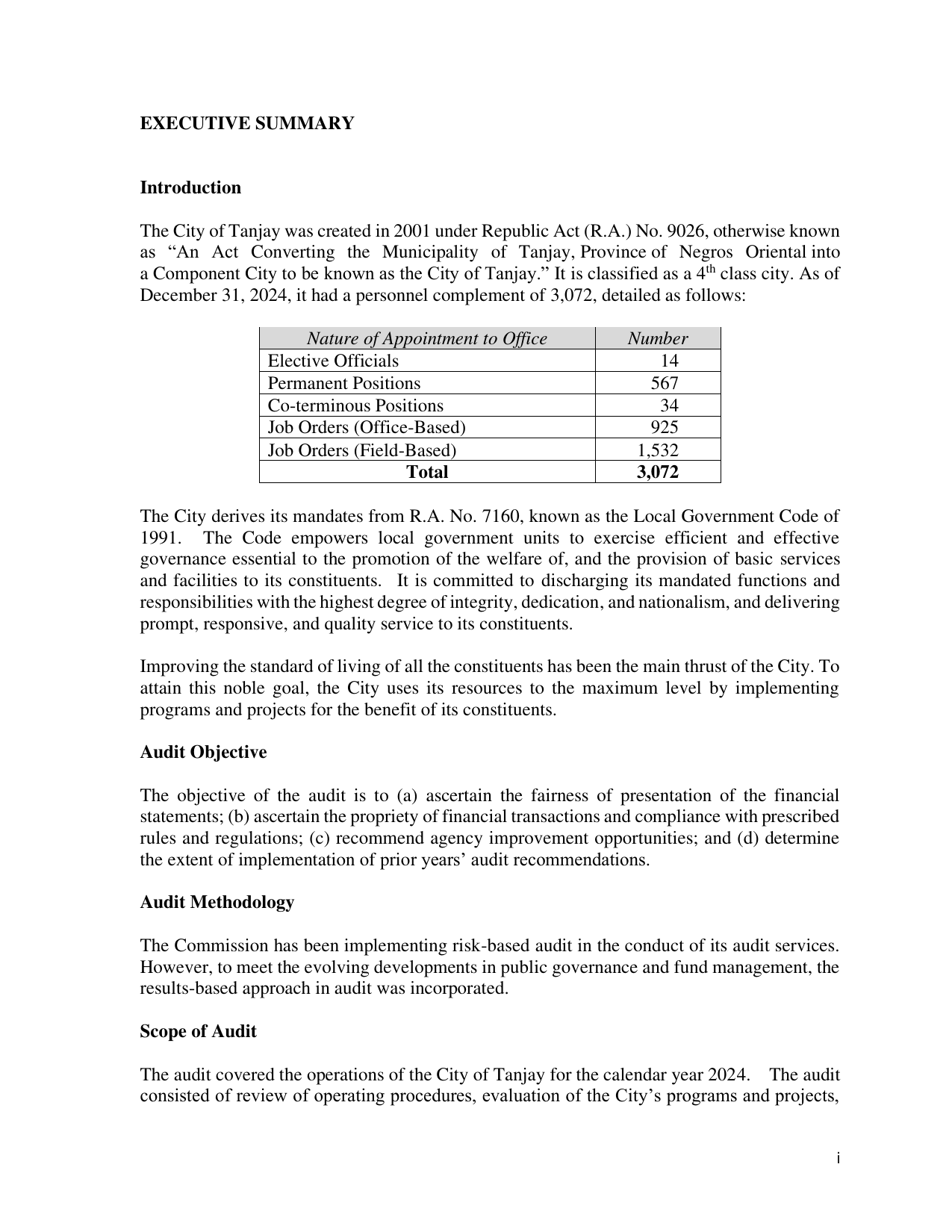
December 31, 2024, it had a personnel complement of 3,072, detailed as follows:

                       Nature of Appointment to Office              Number
                  Elective Officials                                    14
                  Permanent Positions                                  567
                  Co-terminous Positions                                34
                  Job Orders (Office-Based)                            925
                  Job Orders (Field-Based)                           1,532
                                     Total                           3,072

The City derives its mandates from R.A. No. 7160, known as the Local Government Code of
1991. The Code empowers local government units to exercise efficient and effective
governance essential to the promotion of the welfare of, and the provision of basic services
and facilities to its constituents. It is committed to discharging its mandated functions and
responsibilities with the highest degree of integrity, dedication, and nationalism, and delivering
prompt, responsive, and quality service to its constituents.

Improving the standard of living of all the constituents has been the main thrust of the City. To
attain this noble goal, the City uses its resources to the maximum level by implementing
programs and projects for the benefit of its constituents.

Audit Objective

The objective of the audit is to (a) ascertain the fairness of presentation of the financial
statements; (b) ascertain the propriety of financial transactions and compliance with prescribed
rules and regulations; (c) recommend agency improvement opportunities; and (d) determine
the extent of implementation of prior years’ audit recommendations.

Audit Methodology

The Commission has been implementing risk-based audit in the conduct of its audit services.
However, to meet the evolving developments in public governance and fund management, the
results-based approach in audit was incorporated.

Scope of Audit

The audit covered the operations of the City of Tanjay for the calendar year 2024. The audit
consisted of review of operating procedures, evaluation of the City’s programs and projects,


                                                                                                 i