EXECUTIVE SUMMARY

Introduction

The Municipality of Santa Catalina, Province of Negros Oriental, was formerly called
Tolong Viejo, a barrio of Tolong Nuevo (now named Bayawan City). On December 19,
1947, President Manuel Roxas issued Executive Order No. 111 making Sta. Catalina the
26th Municipality of Negros Oriental with 22 component barangays. The Municipality
covers 523.10 square kilometers, with a majority of its area classified as rural. Only one
barangay is urbanized. Based on the CY 2020 census, it had a total population of 77,501.
It is classified as a 1st class Municipality. Pursuant to Republic Act No. 7160, the
Municipality, like all other government units, enjoys total independence in managing and
planning its own administrative, fiscal, and development affairs in conformity with the
national government’s thrust for sustainable social and economic growth. As of December
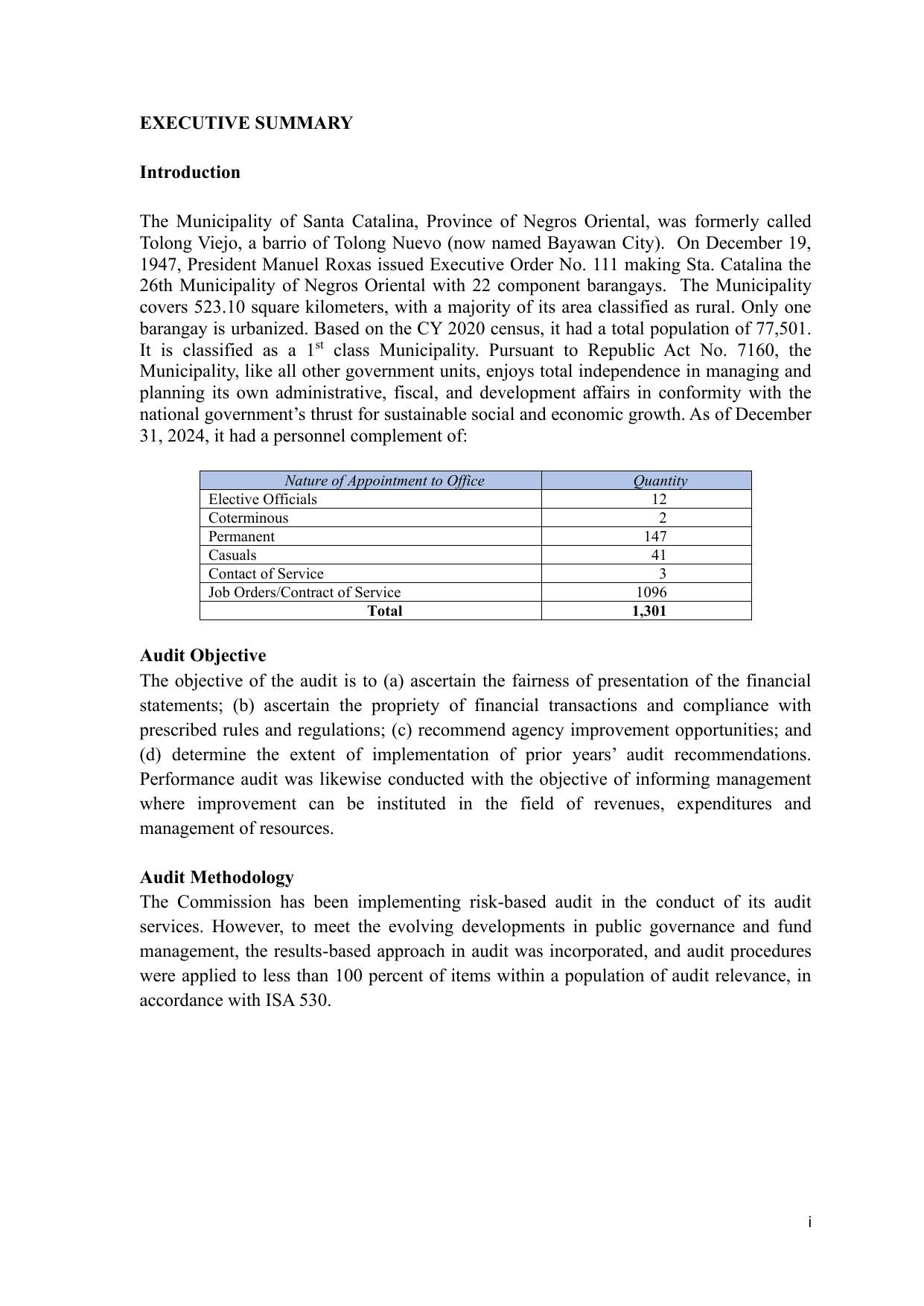
31, 2024, it had a personnel complement of:

                     Nature of Appointment to Office               Quantity
         Elective Officials                                           12
         Coterminous                                                   2
         Permanent                                                   147
         Casuals                                                      41
         Contact of Service                                            3
         Job Orders/Contract of Service                             1096
                                  Total                            1,301

Audit Objective
The objective of the audit is to (a) ascertain the fairness of presentation of the financial
statements; (b) ascertain the propriety of financial transactions and compliance with
prescribed rules and regulations; (c) recommend agency improvement opportunities; and
(d) determine the extent of implementation of prior years’ audit recommendations.
Performance audit was likewise conducted with the objective of informing management
where improvement can be instituted in the field of revenues, expenditures and
management of resources.

Audit Methodology
The Commission has been implementing risk-based audit in the conduct of its audit
services. However, to meet the evolving developments in public governance and fund
management, the results-based approach in audit was incorporated, and audit procedures
were applied to less than 100 percent of items within a population of audit relevance, in
accordance with ISA 530.


                                                                                           i