documents supporting the Disbursement Vouchers (DVs), we found that the mode
      of procurement used was either Shopping or Small Value Procurement (SVP).
      However, we noted the absence of a Bids and Awards Committee (BAC) resolution
      providing valid justification and recommending the use of either Shopping or SVP
      for procuring these goods.

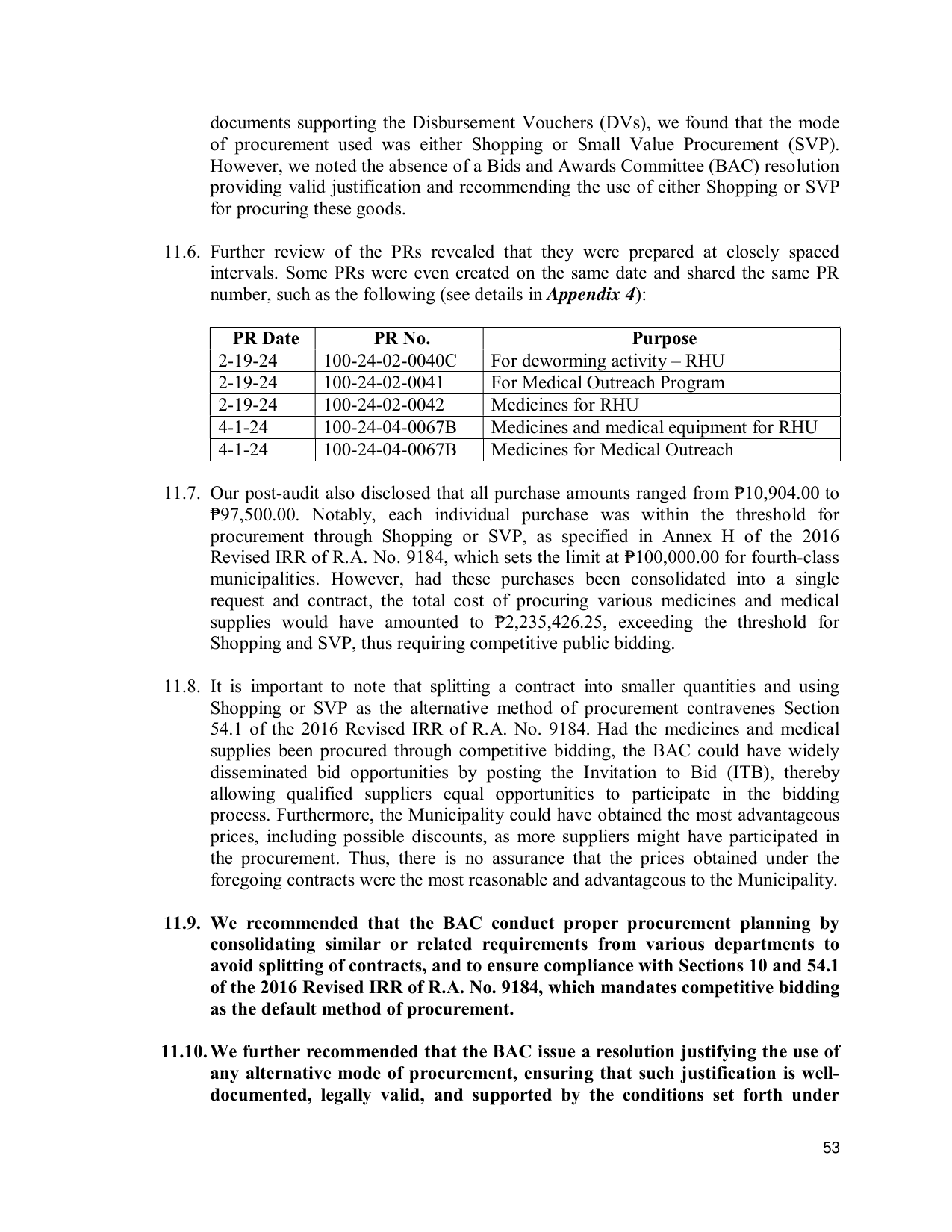
11.6. Further review of the PRs revealed that they were prepared at closely spaced
      intervals. Some PRs were even created on the same date and shared the same PR
      number, such as the following (see details in Appendix 4):

         PR Date           PR No.                           Purpose
       2-19-24       100-24-02-0040C       For deworming activity – RHU
       2-19-24       100-24-02-0041        For Medical Outreach Program
       2-19-24       100-24-02-0042        Medicines for RHU
       4-1-24        100-24-04-0067B       Medicines and medical equipment for RHU
       4-1-24        100-24-04-0067B       Medicines for Medical Outreach

11.7. Our post-audit also disclosed that all purchase amounts ranged from ₱10,904.00 to
      ₱97,500.00. Notably, each individual purchase was within the threshold for
      procurement through Shopping or SVP, as specified in Annex H of the 2016
      Revised IRR of R.A. No. 9184, which sets the limit at ₱100,000.00 for fourth-class
      municipalities. However, had these purchases been consolidated into a single
      request and contract, the total cost of procuring various medicines and medical
      supplies would have amounted to ₱2,235,426.25, exceeding the threshold for
      Shopping and SVP, thus requiring competitive public bidding.

11.8. It is important to note that splitting a contract into smaller quantities and using
      Shopping or SVP as the alternative method of procurement contravenes Section
      54.1 of the 2016 Revised IRR of R.A. No. 9184. Had the medicines and medical
      supplies been procured through competitive bidding, the BAC could have widely
      disseminated bid opportunities by posting the Invitation to Bid (ITB), thereby
      allowing qualified suppliers equal opportunities to participate in the bidding
      process. Furthermore, the Municipality could have obtained the most advantageous
      prices, including possible discounts, as more suppliers might have participated in
      the procurement. Thus, there is no assurance that the prices obtained under the
      foregoing contracts were the most reasonable and advantageous to the Municipality.

11.9. We recommended that the BAC conduct proper procurement planning by
      consolidating similar or related requirements from various departments to
      avoid splitting of contracts, and to ensure compliance with Sections 10 and 54.1
      of the 2016 Revised IRR of R.A. No. 9184, which mandates competitive bidding
      as the default method of procurement.

11.10. We further recommended that the BAC issue a resolution justifying the use of
       any alternative mode of procurement, ensuring that such justification is well-
       documented, legally valid, and supported by the conditions set forth under

                                                                                      53