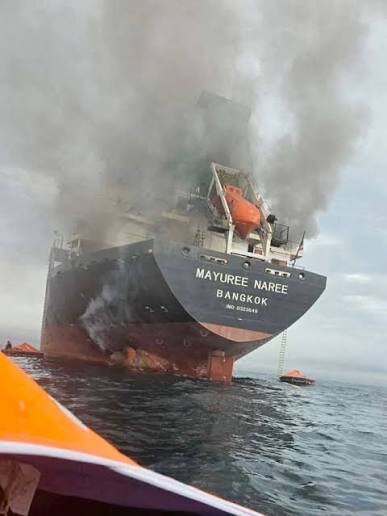
For years, the Strait of Hormuz has lived in the public imagination as one of the world’s most dangerous maritime chokepoints, a narrow artery forever one missile strike or naval clash away from paralysis. Every time tensions rise between Iran and its adversaries, the same fear returns: that Tehran could close the strait and choke the global economy.
But that familiar narrative misses the deeper truth of modern power.
The Strait of Hormuz does not always need to be closed by Iran, or by any navy at all. It can be brought nearly to a halt by something far less dramatic and, in many ways, far more decisive: the withdrawal of insurance.
That is the hidden architecture of global trade. Warships may dominate the headlines, but insurers often determine whether ships move in the first place. In moments of extreme risk, it is not necessarily a missile battery, a minefield or a patrol boat that stops commerce. It can be a risk committee, a reinsurance desk, or a spreadsheet in London.
The world’s most important oil passage depends not only on geography and military balance, but on confidence — confidence that cargoes can be insured, liabilities covered and catastrophic losses absorbed. Once that confidence disappears, trade can seize up with startling speed.
Under normal conditions, roughly a hundred cargo vessels a day pass through the Strait of Hormuz, carrying the energy lifeblood of the global economy. Crude oil, liquefied natural gas, refined products and bulk cargo move through that narrow waterway between Iran and Oman toward Asia, Europe and beyond. It is one of the most indispensable maritime corridors on earth.
But when war-risk calculations change, the ships do not simply keep sailing out of bravery or necessity. They wait. Charterers hesitate. Shipowners reassess. Freight rates jump. Crews worry. Ports prepare for disruption. And above all, insurers begin asking whether the risk is still insurable at a price anyone is willing to pay.
That question matters because global shipping does not run on steel hulls alone. It runs on insurance.
A modern tanker worth $100 million to $150 million will not move without proper coverage. No serious owner wants to expose vessel, cargo, crew and corporate balance sheet to wartime losses without protection. Banks financing the cargo demand coverage. Charterers demand coverage. Port authorities may require it. Without insurance, a ship may as well be anchored permanently.
The shipping world is bound together by a concentrated insurance system. A relatively small circle of maritime protection and indemnity clubs covers most of the world’s oceangoing fleet. Those clubs, in turn, rely heavily on reinsurance markets — and those markets have long been centered in London, through Lloyd’s and other institutions that sit quietly at the core of maritime capitalism.
That is why the old image of geopolitical control is increasingly incomplete. Governments still command armies, navies and sanctions regimes. But private financial systems now hold veto power over movement itself. If reinsurers judge the risk too high, coverage is withdrawn or repriced into near impossibility. When that happens, ships do not sail, no matter what governments say in public.
In that sense, the Strait of Hormuz can be functionally closed without ever being formally blocked.
And the consequences are not distributed evenly.
Iran is often portrayed as the actor most capable of weaponizing the strait. Yet it is also among the first to suffer from major disruption there. Much of Iran’s oil export capacity depends on that route. If shipping traffic collapses, Iranian barrels struggle to reach customers. Revenue falls. At a moment when the state may be seeking strategic leverage, its own economic lifeline is squeezed. The oil weapon, so often described as an Iranian threat, can recoil against Iran itself.
China is perhaps the most exposed major power in this equation. Beijing’s energy system is deeply intertwined with Gulf flows. A significant share of Chinese crude imports transits Hormuz, as do shipments of Iranian oil and Qatari liquefied natural gas bound for Chinese markets. A sustained freeze in traffic through the strait would not merely raise prices for China; it would challenge one of the foundations of its energy security. That helps explain why Beijing, whatever its broader geopolitical alignment, has strong incentives to press for de-escalation whenever Hormuz is threatened.
Then there are the Gulf producers themselves: Saudi Arabia, the United Arab Emirates, Qatar, Kuwait and Iraq. Their export models remain tied to the strait to varying degrees, and the volumes involved are enormous. Around one-fifth of the world’s petroleum consumption is linked to flows through Hormuz. Alternative routes exist only in limited form. Pipelines can bypass some cargo, but not enough to replace the full scale of seaborne exports. If the strait falters, the Gulf’s economic bloodstream falters with it.
There are also geopolitical beneficiaries, at least in the short term. Russia stands to gain from any disruption that drives oil prices higher and tightens the market for Asian buyers. If Gulf supplies become more uncertain or more expensive to transport, Russian crude becomes more attractive. Higher prices can mean larger revenues for Moscow, especially if conflict elsewhere has already elevated energy insecurity.
India, meanwhile, faces the familiar vulnerability of a fast-growing economy heavily dependent on imported energy. New Delhi has diversified its supply sources more than many countries, buying from Gulf producers, Russia and others. That gives it more flexibility than a single-source importer. But diversification does not equal immunity. If Hormuz becomes unstable for a prolonged period, India will still face higher shipping costs, inflationary pressure and greater exposure to external shocks.
The deeper lesson is not simply about oil, or Iran, or even the Gulf.
It is about the nature of power in the 21st century.
Modern geopolitics is no longer governed only by presidents, admirals and generals. It is governed by systems — energy systems, financial systems, insurance systems — that operate in the shadows of public attention while quietly determining what is possible. Missiles can terrify markets. Mines can alter naval calculations. But actuaries and underwriters often decide whether commerce continues at all.
The world still notices the explosions first. That is natural. Violence is visible. Markets are not.
Yet in crises like Hormuz, the true gatekeepers may not be the men who command fleets, but the institutions that price risk. They do not fire weapons. They do not issue ultimatums. They run models, calculate exposure and decide whether loss is tolerable.
And when they decide it is not, one of the world’s most vital waterways can fall eerily silent — not because a navy closed it, but because the financial machinery of global trade refused to let it move. ©️KuryenteNews